
Table of Contents
Since 1 January 2026, visitors who are not U.S. residents pay an extra $100 per person (age 16 and over) at 11 of the busiest U.S. national parks, on top of the normal entrance fee. This guide explains the US national park fee for foreigners: which parks charge it, what you pay at the gate, when the $250 America the Beautiful Non-Resident Annual Pass is cheaper, and how the fee works on bus tours.
Last checked: 14 October 2026. Primary sources: the National Park Service pages Nonresident Fees (last updated 15 July 2026), Entrance Fee Prices (last updated 1 January 2026) and Nonresident Fees on Commercial Tours, plus each park’s own fees page. This page is not based on a personal visit, and it is not legal or immigration advice. Fees can change, so check nps.gov before you travel.
The short answer
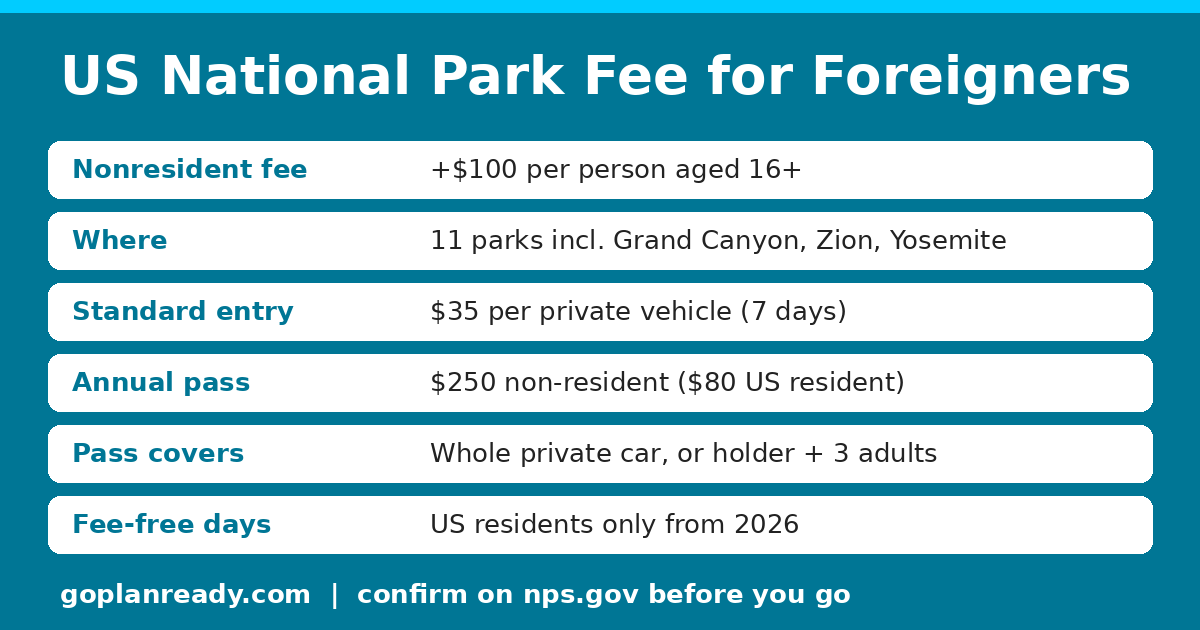
- Who pays: every non-U.S. resident aged 16 or older entering one of the 11 listed parks.
- How much: the park’s standard entrance fee plus $100 per person. The $100 is per person, not per car.
- Children under 16: the NPS pages set the $100 fee for ages 16 and over only.
- The pass option: the America the Beautiful Non-Resident Annual Pass costs $250 and covers entrance fees and nonresident fees for the pass holder and everyone in the same private vehicle (or the holder plus three more adults where fees are per person).
- Fee-free days: from 2026 they apply to U.S. residents only. Nonresidents pay the normal entrance fee and the nonresident fee on those days.
Which national parks charge the $100 nonresident fee?
The NPS lists exactly 11 parks. The table shows each park’s standard 7-day private-vehicle pass as published on the park’s own fees page (checked 14 October 2026). The $100 is added per nonresident aged 16+.
| National park | Standard private vehicle (7 days) | Per person (foot/bike) | Nonresident fee |
|---|---|---|---|
| Acadia (Maine) | $35 | $20 | +$100 per person 16+ |
| Bryce Canyon (Utah) | $35 | $20 | +$100 per person 16+ |
| Everglades (Florida) | $35 | $20 | +$100 per person 16+ |
| Glacier (Montana) | $35 (winter rate $25) | $20 (winter $15) | +$100 per person 16+ |
| Grand Canyon (Arizona) | $35 | $20 | +$100 per person 16+ |
| Grand Teton (Wyoming) | $35 | $20 | +$100 per person 16+ |
| Rocky Mountain (Colorado) | $35 (1-day vehicle pass $30) | $20 (1-day $15) | +$100 per person 16+ |
| Sequoia & Kings Canyon (California) | $35 | $20 | +$100 per person 16+ |
| Yellowstone (Wyoming/Montana/Idaho) | $35 | $20 | +$100 per person 16+ |
| Yosemite (California) | $35 | $20 | +$100 per person 16+ |
| Zion (Utah) | $35 | $20 | +$100 per person 16+ |
Motorcycle passes are $30 for 7 days at these parks (Rocky Mountain also sells a $25 one-day motorcycle pass, and Glacier lists lower winter rates). Some parks also need a separate timed-entry or vehicle reservation in season. For example, Acadia’s Cadillac Summit Road reservation costs $6.00. Reservations are not covered by the entrance fee.
Other national parks and NPS sites charge their normal entrance fee only, or no fee. The NPS Entrance Fee Prices page names only the 11 parks above for the nonresident fee.
What a foreign visitor actually pays at the gate
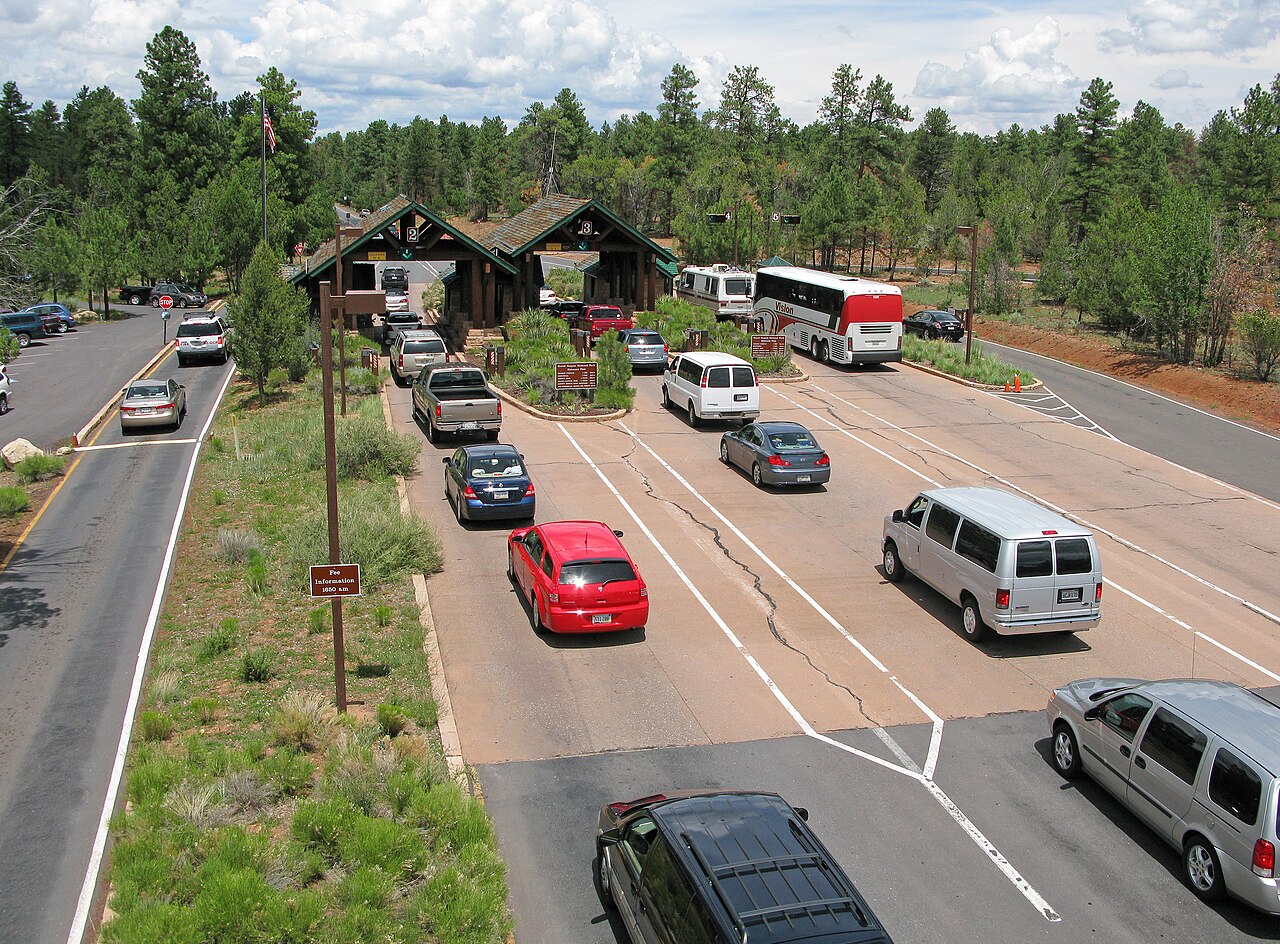
NPS: “Non-U.S. residents will pay the standard entrance fee at each of these parks, plus a $100 fee per person aged 16 or older.” Worked examples using the $35 vehicle fee:
| Group in one private car, one park | Entrance | Nonresident fees | Total at the gate |
|---|---|---|---|
| 1 adult | $35 | $100 | $135 |
| 2 adults | $35 | $200 | $235 |
| 2 adults + 2 children under 16 | $35 | $200 | $235 |
| 2 adults + one 17-year-old + one 12-year-old | $35 | $300 | $335 |
The entrance pass stays valid for 7 days at that park. Nothing on the NPS pages says the $100 fee is charged again on re-entry within those 7 days. If you plan to leave and come back, confirm with the park.
When the $250 Non-Resident Annual Pass is cheaper
The NPS says the America the Beautiful annual pass now has two prices from 1 January 2026: $80 for U.S. residents and $250 for nonresidents. The $250 pass covers “the entire vehicle, or 2 motorcycles, or the passholder plus three additional adults in their party (where per-person rather than per-vehicle fees are charged)”. It also covers the nonresident fees for those passengers, and it is valid for 12 months.
- One park, 1 adult: $135 at the gate. Pay at the gate.
- One park, 2 adults: $235 at the gate vs $250 for the pass. Pay at the gate (only $15 cheaper, and only if you visit no other fee park).
- One park, 3 or more adults in one car: $335 or more. The $250 pass is cheaper.
- Two or more of the 11 parks: even a solo traveller pays $270 for two parks. The pass is almost always cheaper.
Worked example: Indian family doing Grand Canyon, Zion and Bryce
Two parents and two children aged 17 and 12, travelling by rental car:
- Paying at each gate: ($35 + 3 × $100) × 3 parks = $1,005.
- With one Non-Resident Annual Pass in a parent’s name: $250 for all three parks (the pass holder must be present and show photo ID).
Buy the pass at a park entrance or as a digital pass on Recreation.gov. NPS says digital pass buyers show a photo ID when they use it, and anyone who is not eligible for the resident pass is asked to upgrade to the nonresident pass.
A valid annual pass bought before 1 January 2026 is honoured on its original terms for 12 months from purchase. It covers entrance fees and nonresident fees for the holder and passengers in a private vehicle.
Who counts as a U.S. resident?
The NPS pages do not define residency by visa type. They list the documents accepted as proof of U.S. citizenship or residency when buying the $80 resident pass: a U.S. passport, a U.S. government (state or territory)-issued driver’s licence or state ID, or a Permanent Resident card (“green card”). Fortune (10 September 2026) reports that visitors without a pass at the 11 parks now get a verbal residency check at the gate.
If you live in the U.S. on a work or study visa, the official pages do not answer your case directly. Carry the documents above if you have them, and ask the park before you travel. This page does not guess.
How the fee works on bus and group tours
According to the NPS commercial-tours FAQ:
- The $100 fee applies to nonresidents on commercial tours too. Tour operators must know how many nonresidents and pass holders they have before entering.
- One Non-Resident Annual Pass covers the $100 fee for the holder and three additional nonresidents aged 16+ in a commercial group, plus the per-person commercial entrance fee for those four people.
- Since June 2026, tour operators can prepay commercial entrance and nonresident fees as a “Commercial Site Pass” on Recreation.gov.
- Digital non-resident passes are issued to one named person, who must be present with ID. They are not transferable.
If your tour price says “park fees included”, ask whether that includes the $100 nonresident fee.
Fee-free days: not for nonresidents
NPS: “Beginning in 2026, fee free days at national parks will only be for U.S. residents. Non-U.S. residents will have to pay the entrance fee and nonresident fee as normal.” Grand Canyon’s fees page lists 2026 fee-free dates such as 16 February, 25 May, 14 June and 3–5 July. Those dates do not cut the cost for foreign visitors.
Recent news (last 12 months)
- Policy start: the nonresident fee and the $250 pass took effect on 1 January 2026, following Executive Order 14314 of 3 July 2025 (NPS; Fortune).
- Revenue: Fortune (10 September 2026) reports that Interior Secretary Doug Burgum said the fee raised about $22.5 million in its first six months, against a projected $90 million a year.
- Lawsuit: on 28 September 2026, Across Arizona Tours sued in the U.S. District Court for Arizona, arguing the agencies lack authority to charge nonresidents more (The Hill; Pacific Legal Foundation). As of 14 October 2026 we found no ruling. The fee still applies until NPS says otherwise.
- Entry queues: The Guardian (8 January 2026) reported long lines in the first week as residency checks began.
Money-saving tips for international visitors
- Plan your route first. If it includes two or more of the 11 parks, buy the $250 pass before your first gate.
- Put the pass in the name of an adult who will be at every park.
- Travel in one private vehicle. The pass covers everyone inside, and children under 16 never pay the $100.
- Many famous U.S. parks are not on the list (for example Joshua Tree, Death Valley and Arches). They charge only their normal entrance fee.
- Book any timed-entry or road reservations separately. The pass does not include them.
Park guides on goplanready
- Grand Canyon National Park tickets
- Bryce Canyon National Park tickets
- Rocky Mountain National Park tickets
- Zion National Park guide
- Yosemite National Park guide
- Thailand national park entrance fees (another country with foreigner pricing)
FAQ
How much is the US national park fee for foreigners?
At 11 parks, non-U.S. residents aged 16+ pay $100 per person on top of the standard entrance fee (usually $35 per private vehicle for 7 days). Other NPS sites charge only their normal fee.
Do children pay the $100 nonresident fee?
No. NPS applies it to nonresidents aged 16 and older.
Is the $250 Non-Resident Annual Pass worth it?
Yes, if you visit two or more of the 11 parks, or one park with three or more adults in the same car. For one or two adults at a single park, paying at the gate is slightly cheaper.
Does the nonresident pass cover my whole car?
Yes. NPS says it covers entrance and nonresident fees for the holder and passengers in a private vehicle, or the holder plus three adults where fees are per person.
Can foreigners use fee-free days?
No. From 2026, fee-free days are for U.S. residents only.
