
Table of Contents
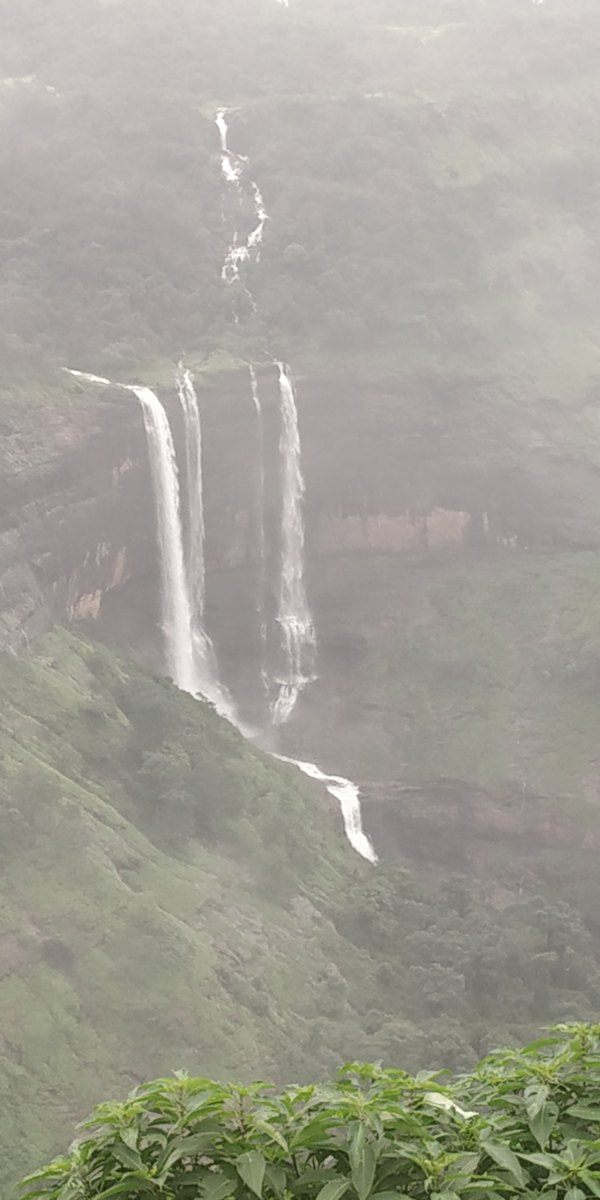
Kune Falls, Lonavala, in short: Kune Falls is a seasonal, three-tier waterfall about 200 m high at Kune village, between Khandala and Lonavala in Pune district. It is only worth the trip in the monsoon, roughly July to September. No government website publishes an entry fee, opening hours or access rules for Kune Falls. Travel listings say there is no ticket, but several also say that the approach road and the land around the falls are private property, so visitors cannot get close and see the falls from a distance. In our checks, the falls were not named in any reported 2026 monsoon ban order. The Pune Collector’s Lonavala order (planned for 6 July to 31 August 2026) was revoked on 16 July 2026, and no new order for the area was reported as of 25 October 2026.
Last checked: 25 October 2026. We checked the Department of Tourism, Government of Maharashtra website (maharashtratourism.gov.in), which has a Lonavala page but no Kune Falls page, and the Pune district website (pune.gov.in), plus English and Marathi news from the last 12 months. We have not visited Kune Falls ourselves. Where a detail comes only from a travel listing or a newspaper, we say so.
Kune Falls at a glance
| Item | What we found | Source |
|---|---|---|
| Where | Kune village, Khandala–Lonavala, Pune district, Maharashtra | Wikipedia; travel listings |
| Height | About 200 m in 3 tiers; longest drop about 100 m | Wikipedia (citing the World Waterfalls Database) |
| Entry fee | No official fee published; listings say free | No official page; listings |
| Timings | No official hours; listings say 6 AM–6 PM (daylight) | Listings only |
| Can you go close? | Several listings say no: the approach road and land are private, so you view from a distance | Listings and visitor reviews (not official) |
| 2026 monsoon ban | Not named in the reported lists; Lonavala order of 6 July revoked on 16 July 2026 | Punekar News, Lokmat, Mid-day (July 2026) |
| Best time | July to September (monsoon flow) | Listings; Maharashtra Tourism (for Lonavala: June–September) |
| Nearest stations | Khandala (about 1.4 km in a straight line) and Lonavala (about 3.3 km in a straight line) | Our calculation from map coordinates |
Can you visit Kune Falls? Access and private land
This is the main thing to know before you go. We found no government notice, signboard text or official page that says Kune Falls is open to the public, closed, or ticketed. The information comes from travel listings, and it is mixed:
- Trawell.in says: “Currently, the approached road to Kune Falls is a private property. So, visitors are not allowed to visit the falls.” The page is undated.
- Events Khabar says you cannot get too close because of private property restrictions, and that the falls are seen from a viewing point.
- LonavalaKhandalaTourism.in (updated 3 November 2025) says most of the land is private and that police block access near the falls in heavy rain.
- A summary of visitor reviews on Airial says access to the base may be restricted, that the road to the falls is rough and rocky, and that if you cannot get close, the Khandala Monkey Viewpoint gives a distant view.
What this means for you: plan to see Kune Falls from a distance, from a public road or a viewpoint. Do not cross gates, fences or private land, and do not try to climb down to the base. If someone at the site says an area is private or closed, follow that. We could not confirm the exact position of any public viewpoint, so ask locals when you reach Kune village.
Kune Falls entry fee and timings
No official fee or timing is published for Kune Falls. Travel listings (LonavalaKhandalaTourism.in, Events Khabar) say there is no entry fee and give daylight hours of about 6 AM to 6 PM. This is not an official timetable; it simply reflects that it is not safe to be near the cliffs after dark. One listing says some private parking areas may charge a small fee. If you are asked to pay at a gate, you are probably entering private land, so ask what the payment is for. One 2026 travel blog says the site was developed by MTDC with a ₹30 entry. We found nothing on the Maharashtra Tourism website to support this, so we have not used it.
How to reach Kune Falls
By train
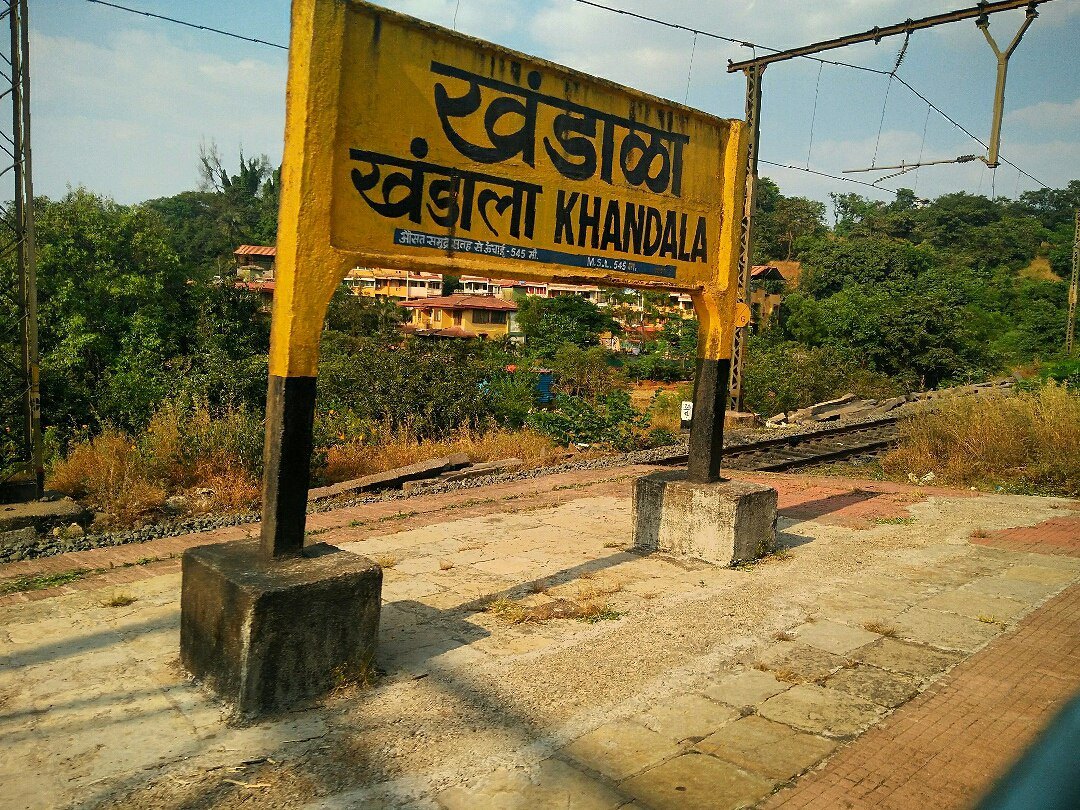
Lonavala has its own railway station on the Mumbai–Pune line, with frequent trains between the two cities (Maharashtra Tourism). The Pune district website says local trains run from Pune station to Lonavala. Khandala station, on the same line, is closer to Kune: by our calculation from map coordinates, Kune Falls is about 1.4 km in a straight line from Khandala station and about 3.3 km from Lonavala station. Travel listings give road distances of about 2 km from Khandala station and 3.5–4 km from Lonavala station. Fewer trains may stop at Khandala, so check your train on NTES or IRCTC before you plan around it. From either station, take an auto-rickshaw or taxi to Kune village.
By road
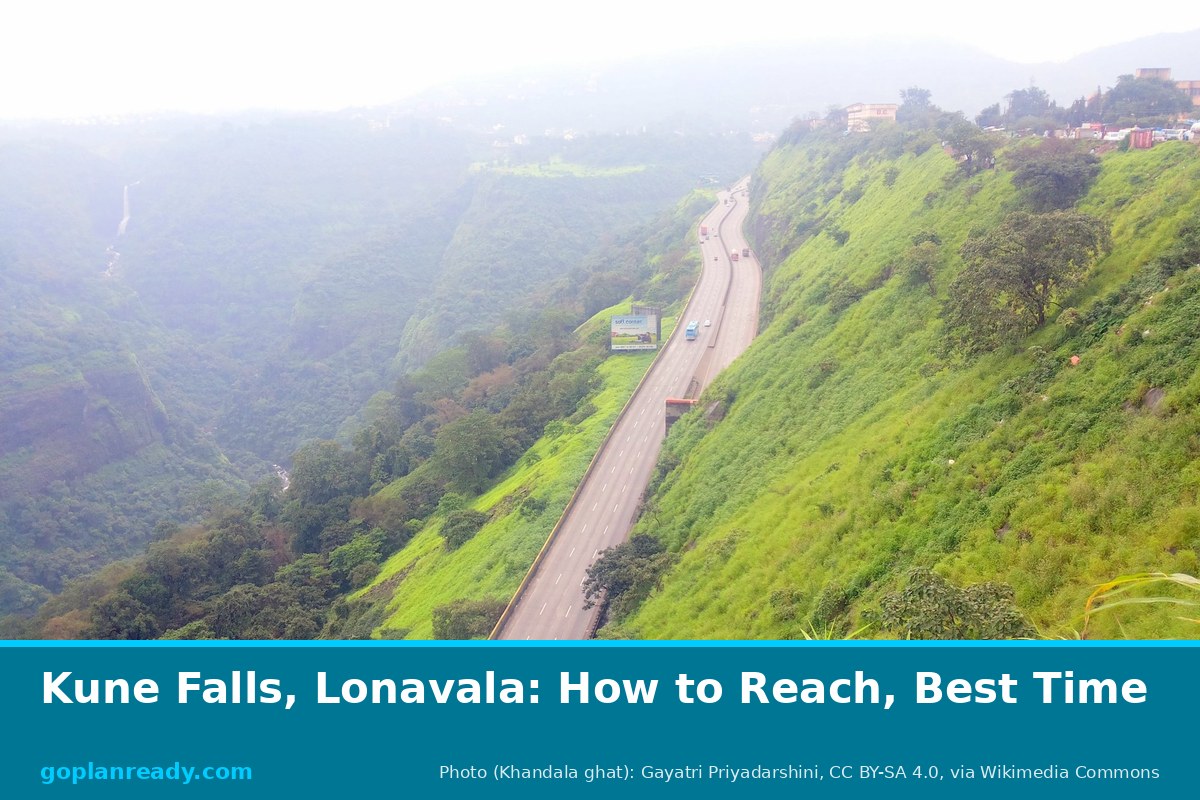
Maharashtra Tourism puts Lonavala about 65 km from Pune and 83 km from Mumbai, about a two-hour drive. The Pune district website says the drive takes about 1.5 hours from Pune and 2 hours from Mumbai. Travel listings place Kune village on the Khandala side of Lonavala, off the old Mumbai–Pune highway, and name Kune Church as a landmark. Visitor reviews say the last stretch is a rough road where low cars may scrape, and that map pins are not always precise.
From the expressway
One travel site says the falls can be seen from the Mumbai–Pune Expressway in the monsoon. Do not stop on the expressway to look or take photos. Pull over only where parking is allowed.
Best time to visit, and what to expect in late October
Kune Falls depends on rain. Listings describe July to September as the peak, and Maharashtra Tourism calls the monsoon (June to September) the most popular season in Lonavala, with “cascading waterfalls”. After the monsoon the flow drops, and listings say the falls are mostly dry in summer. We could not confirm how much water Kune Falls has today (late October 2026). Expect a thinner flow than in the photos you see online, or very little. Maharashtra Tourism calls October to February a good season for trekking and sightseeing around Lonavala, so in winter plan the trip around other spots.
Lonavala gets very busy on long weekends. Punekar News reported heavy crowds and long traffic queues on the Mumbai–Pune highway over the long weekend around Gandhi Jayanti (2 October 2026). Go early on a weekday if you can.
Monsoon bans and rules in Lonavala in 2026
Each monsoon, the Pune district administration can restrict tourists at Lonavala and Maval spots under Section 163 of the Bharatiya Nagarik Suraksha Sanhita (BNSS), the law that replaced Section 144 of the old CrPC. Here is what was reported in 2026:
| Date (2026) | What happened | Source |
|---|---|---|
| 5 July | Bhushi Dam in Lonavala closed to tourists for safety after heavy rain | GSTV (5 July) |
| 6 July | Pune Collector’s Section 163 order for spots under Lonavala Rural Police, planned for 6 July–31 August: Ekvira Devi temple, Karla and Bhaja caves, Bhaja waterfall, Lohagad, Visapur, Tikona and Tung forts, Tiger Point, Lion’s Point, Shivling Point, Pawna Dam and other spots. One Marathi report says it applied daily from 6 AM to midnight and also lists Bhushi. | Times of India (12 July); Letsupp (6 July); Punekar News (16 July) |
| 16 July | Collector Jitendra Dudi revoked the 6 July order because the rain had eased | Punekar News, Pune Pulse, Lokmat (16 July); Mid-day (18 July) |
| 8 August | One Marathi news site reported that Bhushi Dam and other spots in the region were shut “until further orders” after a red alert. We found no official notice. | Thodkyaat (8 August), single report |
The 2026 order banned entering deep water, sitting under waterfalls, taking selfies on cliffs or other risky spots, loud music, (Times of India, 12 July 2026). Officials also asked visitors not to drive vehicles into water bodies. Even after it was lifted, Punenow (17 July 2026) reported that reels and risky selfies at cliff edges were still not allowed. Expect a similar order again in the 2027 monsoon, and check the news before you go.
Safety at Kune Falls
- Stay away from cliff edges. On 8 February 2026 a 26-year-old visitor died after falling 70–80 feet into a gorge while taking a selfie on Khandala hill at sunset (Lokmat Times, citing Maharashtra Times). That was not reported at Kune Falls, but it shows the risk on the Khandala cliffs.
- Do not go into the water or under the falls. Travel sites (Hidden Routes, Weekend Wander) warn that the stream below can surge suddenly in the monsoon.
- Stay off private land and follow police or local instructions. In heavy rain, police may block the way near the falls (LonavalaKhandalaTourism.in).
- Go in daylight, carry rain gear, and take your rubbish back. Maharashtra Tourism asks visitors not to litter near waterfalls and trails.
Facts about the falls
Wikipedia, citing the World Waterfalls Database (2010), describes Kune Falls as a three-tier waterfall with a total height of about 200 m (660 ft) and a longest drop of about 100 m, and ranks it the 14th highest waterfall in India. Lonavala and Khandala are twin hill stations about 622 m above sea level in the Sahyadri range (Pune district website). One travel site (LonavalaKhandalaTourism.in) says the falls are fed from Tungarli Lake and Lonavala Lake and mark the start of the Ulhas river. We could not find an official source for this, so treat it as unconfirmed.
More waterfalls and day trips near Pune and Mumbai
For other Lonavala spots, such as Lohagad and Bhaja Caves, and their 2026 rules, see our picnic spots near Pune guide. Imagica in Khopoli is just down the ghat; see the Imagica water park ticket price guide, or our list of one-day resorts near Pune. For more monsoon waterfalls in Maharashtra, see Devkund Waterfall trek, Randha Falls, Bhandardara and Lingmala Waterfall, Mahabaleshwar.
FAQ
Is there an entry fee for Kune Falls?
No official fee is published. Travel listings say entry is free, but private parking may charge, and the approach is reported to be on private land.
Is Kune Falls open now?
No authority publishes an open or closed status for Kune Falls. It was not named in the 2026 Lonavala ban order, which was revoked on 16 July 2026. Several listings say visitors cannot go near the falls because the land is private, so plan to view it from a distance.
What are the Kune Falls timings?
There are no official timings. Listings give daylight hours of about 6 AM to 6 PM.
How far is Kune Falls from Lonavala station?
About 3.3 km in a straight line by our calculation. Listings give 3.5–4 km by road. Khandala station is closer, about 1.4 km in a straight line.
Can you swim at Kune Falls?
No. Do not go into the water. The 2026 Lonavala monsoon order banned entering deep water and sitting under waterfalls at the listed spots, and travel sites warn about sudden surges below the falls.
When is the best time to see Kune Falls?
July to September, when the monsoon flow is strongest. From late October onwards the flow is usually much lower.
Sources: maharashtratourism.gov.in (Lonavala page, Department of Tourism, Government of Maharashtra), pune.gov.in (Lonavala-Khandala page, District Pune), Wikipedia (Kune Falls), Times of India (12 July 2026), Letsupp (6 July 2026), GSTV (5 July 2026), Punekar News (16 July and 3 October 2026), Pune Pulse and Lokmat (16 July 2026), Mid-day (18 July 2026), Punenow (17 July 2026), Thodkyaat (8 August 2026), Lokmat Times (12 February 2026), and travel listings named in the text. All checked 25 October 2026. Distances to the stations are our own straight-line calculation. Rules can change, so follow local police instructions on the day.
