

Table of Contents
Humayun’s Tomb ticket price: visitors from India and from SAARC/BIMSTEC countries pay ₹35 online; the Archaeological Survey of India (ASI) page prints ₹50 for cash payment, while the text of the 2018 fee rules reads ₹40 for cash (see the note below). Other foreign visitors pay ₹600 in cash or ₹550 online. Children under 15 enter free. ASI lists the tomb as open from sunrise to 9:00 pm; Delhi Tourism says sunrise to 7:30 pm, and both say it is open every day. New from 4 December 2026: the tomb is a venue of the India Biennale (4 December 2026 to 21 March 2027), and the official Biennale site says one Biennale Pass (from ₹100 for a day) covers participating monuments with “no separate monument ticket required”.
Last checked: 28 November 2026 against the ASI Humayun’s Tomb page (asi.nic.in), the Delhi Tourism page (delhitourism.gov.in), the India Biennale site (indiabiennale.culture.gov.in) and dated news reports. This guide is based on official pages and news reports, not a personal visit.
Humayun’s Tomb ticket price 2026
| Visitor | At the counter (cash) | Online |
|---|---|---|
| Indian citizens (and Overseas Citizens of India, per the 2018 rules) | ₹50 per the ASI page; ₹40 per the 2018 rule text | ₹35 |
| SAARC and BIMSTEC visitors (Bangladesh, Bhutan, Nepal, Sri Lanka, Pakistan, Maldives, Afghanistan; Thailand, Myanmar) | ₹50 | ₹35 |
| Other foreign visitors | ₹600 | ₹550 |
| Children under 15 | Free | |
Where the numbers differ. The ASI page prints ₹50 (cash) / ₹35 (online) under the SAARC and BIMSTEC country list and does not mention “citizens of India”; it prints ₹600 / ₹550 for “Other Foreign Visitor” (with the word “Indian” before the rupee amount, which this guide reads as “Indian rupees”). The Delhi Tourism page shows only two lines, “Foreigner Adults: Rs. 550” and “Indian Adults: Rs. 35”, without saying whether they are online or cash prices. The text of the Ancient Monuments and Archaeological Sites and Remains (Amendment) Rules, 2018, rule 6, groups Indian citizens, SAARC and BIMSTEC visitors and Overseas Citizens of India at ₹35 cashless / ₹40 cash (the ₹50 cash rate in that rule is a proviso for the Red Fort only) and sets ₹550 / ₹600 for all other nationals. So the ₹35 online rate and the ₹550 / ₹600 foreign rates agree across the sources, while the cash price for Indians is ₹50 on the ASI page and ₹40 in the rule text. None of the pages is dated, so check the amount at the counter or at checkout.
Online is cheaper. ₹35 instead of ₹50, or ₹550 instead of ₹600, according to the ASI page. ASI’s online ticket portal is asi.paygov.org.in; its prices load in the browser, so confirm the amount shown at checkout. The museum inside the complex is a separate place (see the Biennale section) and ASI’s page does not list a separate museum ticket.
India Biennale 2026-27: what changes from 4 December
The India Biennale, presented by the Ministry of Culture, runs from 4 December 2026 to 21 March 2027 and lists Humayun’s Tomb among its venues, with the Red Fort and Qutub Minar. The Biennale site says: “One Pass gives you access to participating monuments across Delhi, along with the exhibitions, installations and public programmes taking place within them. No separate monument ticket required.”
| Biennale Pass (official booking page) | Price |
|---|---|
| One Day Pass (valid 1 day) | ₹100 |
| Three Day Pass (valid 3 days) | ₹200 |
| Week Pass (valid 7 days) | ₹400 |
| Season Pass (full season) | ₹3,000 |
| Premium Pass (full season; adds parking, guided walkthroughs, volunteer support) | ₹10,000 |
- Not stated by the Biennale site: whether foreign visitors pay the same pass price, and whether the normal ASI counter and online tickets stay on sale at Humayun’s Tomb during these dates. The pass page shows one price list and does not mention nationality. Check the Biennale site and the ASI portal before travelling after 3 December.
- Before 4 December the ASI fees in the table above apply.
- The Biennale page for Humayun’s Tomb (read 28 November) still showed its exhibitions, experiences and conversations as “Coming Soon”.
- The Italian Cultural Centre in New Delhi lists an exhibition called Brother Wolf at the Humayun’s Tomb Museum (exhibition gallery and museum courtyard) from 4 December 2026 to 31 March 2027, in collaboration with the museum, with “For a fee: No” on its event page. That line is about the exhibition listing; it does not say how the monument ticket works.
Humayun’s Tomb timings and closed days
- ASI: “Open from sunrise to 9.00 p.m.”
- Delhi Tourism: “Sunrise to 7:30 PM (Open All Days)”. The two official pages do not match, so plan to be inside well before 7:30 pm.
- Evening visits: a travel site, Roamer (11 November 2026), notes that evening opening began in January 2025 but that in April 2025 evening visitors were reported to be kept back from the tomb and the counters closed at 6 pm, and advises going in daylight. This is a report, not an ASI notice.
- Weekly closed day: neither official page names one; Delhi Tourism says open all days.
- Last entry: not stated by ASI or Delhi Tourism.
- Conservation work: the Daily Jagran (13 September 2026), citing an RTI-based report, says ASI has put 10 Delhi monuments, including Humayun’s Tomb, on a conservation list, with “public facilities” to be improved at the tomb and tourists barred from active work areas. No closure of the tomb was reported, and none was found in the searches made for this guide.
How to buy Humayun’s Tomb tickets
- Online (cheaper): pay at the ASI portal (asi.paygov.org.in) and keep the QR code.
- At the counter: pay the cash price shown at the window.
- From 4 December 2026: the Biennale Pass is booked on indiabiennale.culture.gov.in and, per that site, replaces a separate monument ticket at participating venues.
- Children under 15 are free.
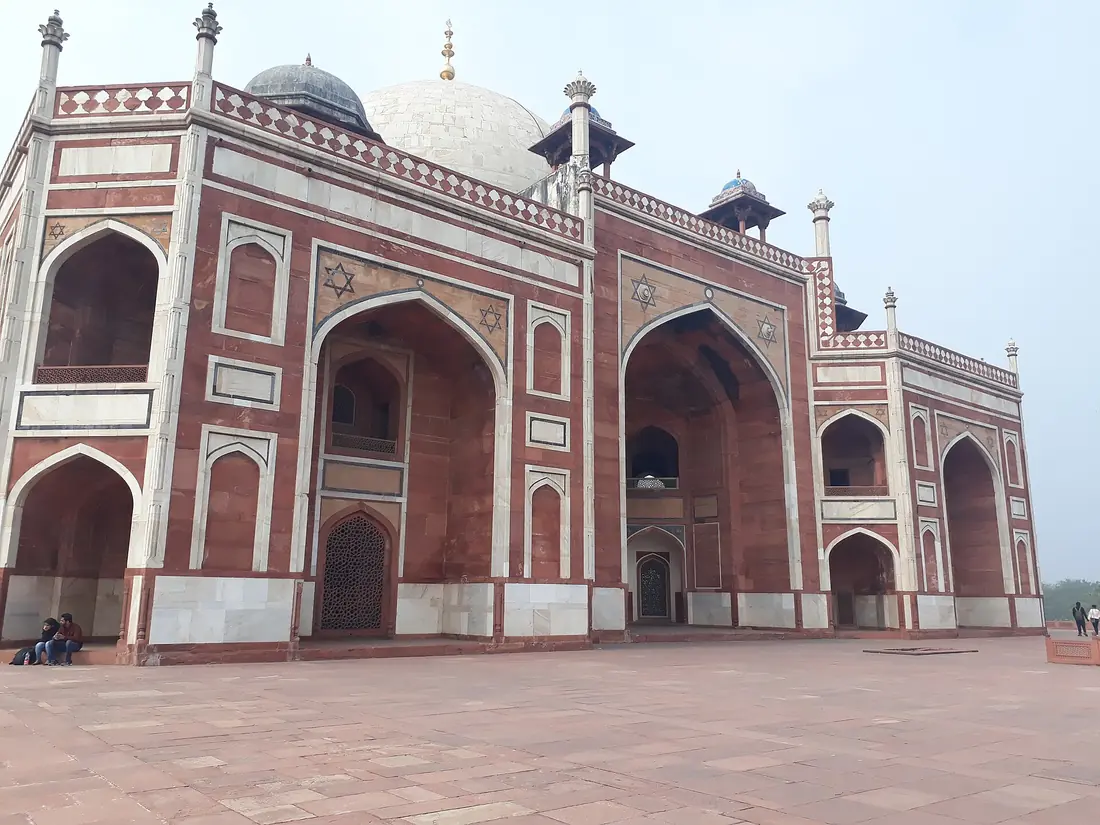
What you see at Humayun’s Tomb
ASI’s description of the tomb (a UNESCO World Heritage Site listed in 1993) says:
- Humayun died in 1556, and his widow Hamida Banu Begam, also known as Haji Begam, began the tomb in 1569. ASI calls it the first distinct example of proper Mughal style, inspired by Persian architecture, built at a cost of 15 lakh rupees by the Persian architect Mirak Mirza Ghiyath. (The Delhi Tourism page dates the build to 1570 and says the site covers 30 acres.)
- The tomb stands in the centre of a square garden divided into four parts by causeways (charbagh), with shallow water channels. The high enclosure is entered through two double-storeyed gateways on the west and south; a baradari (pavilion) sits in the middle of the east wall and a hammam (bath chamber) in the middle of the north wall.
- The red sandstone mausoleum rises from a 7-metre terrace over a series of cells. Its octagonal central chamber holds the cenotaph, and the marble double dome is 42.5 m high, with pillared kiosks (chhatris) around it.
- ASI notes that several rulers of the Mughal dynasty are buried here, that Bahadur Shah Zafar took refuge in the tomb with three princes in 1857, and that the barber’s tomb (Nai-ka-Gumbad) stands to the south-west on a raised platform.
- ASI adds that Humayun’s tomb set a new vogue among garden tombs, “the crowning achievement of which is the Taj at Agra”.
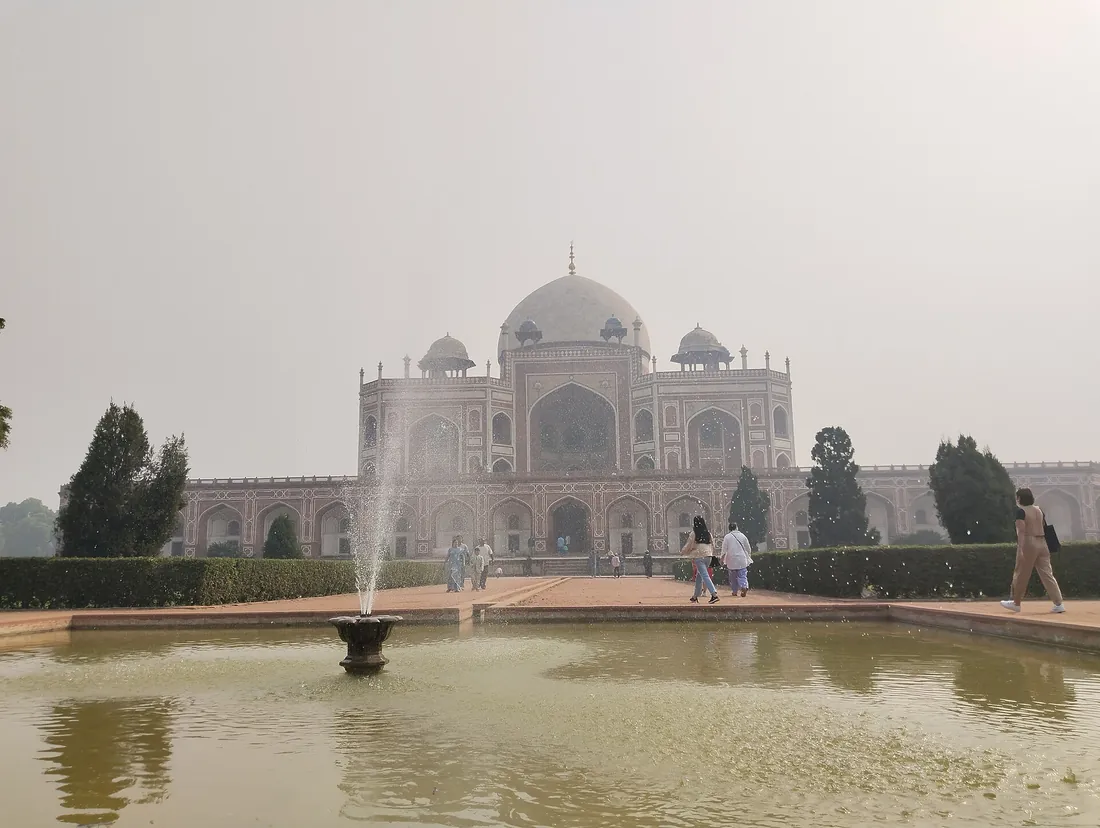
How to reach Humayun’s Tomb
- Address: Humayun’s Tomb Complex, Mathura Road, Nizamuddin East, New Delhi 110013 (Biennale venue page). Delhi Tourism places it near the Nizamuddin Dargah.
- Metro: Delhi Tourism lists Jangpura (Violet Line) as the nearest metro station.
Date checks and watch-points
- 4 December 2026: the Biennale opens; check whether ASI tickets are still sold and what foreign visitors pay.
- After 21 March 2027: the Biennale ends and normal ASI tickets are expected to apply again.
- Fee changes: a draft amendment to ASI’s Second Schedule (Gazette, 8 September 2026, reported by UNI on 9 September) lists Humayun’s Tomb in Category A; it is a draft and takes effect only if finally notified.
Tips before you go
- Pay online if you can: ₹35 against ₹50, or ₹550 against ₹600.
- Carry an ID; foreign and SAARC/BIMSTEC rates depend on nationality.
- Plan the visit in daylight, because the two official pages give different closing times.
- From 4 December 2026, check whether you need a Biennale Pass instead of a normal ticket.
FAQ
What is the Humayun’s Tomb ticket price for Indians?
₹35 online. For cash, the ASI page prints ₹50 and the 2018 fee-rule text says ₹40, so check the amount at the counter. Children under 15 are free.
What is the Humayun’s Tomb ticket price for foreigners?
₹600 at the counter and ₹550 online for visitors from outside the SAARC and BIMSTEC countries, as printed by ASI. SAARC and BIMSTEC visitors pay ₹50 / ₹35.
What are the Humayun’s Tomb timings?
ASI says sunrise to 9:00 pm; Delhi Tourism says sunrise to 7:30 pm. Go in daylight and allow time before the earlier closing time.
Is Humayun’s Tomb open on Monday?
Neither ASI nor Delhi Tourism lists a weekly closed day, and Delhi Tourism says it is open all days.
Do I need a Biennale Pass for Humayun’s Tomb?
From 4 December 2026 to 21 March 2027 the official Biennale site says the pass covers participating monuments, including Humayun’s Tomb, with no separate monument ticket required. It does not say whether normal ASI tickets are still sold or whether foreign visitors pay a different price, so check before you go.
Related guides
- Red Fort ticket price 2026
- Qutub Minar ticket price 2026
- Taj Mahal ticket price 2026
- Delhi Zoo ticket price
Sources (checked 28 November 2026)
- Archaeological Survey of India: World Heritage Site – Humayun’s Tomb, Delhi (opening hours, fees, description).
- Delhi Tourism: Humayun’s Tomb (timings, fees, nearest metro).
- Ancient Monuments and Archaeological Sites and Remains (Amendment) Rules, 2018, rule 6, text as reproduced by LegitQuest.
- India Biennale: venues, Humayun’s Tomb venue page and Biennale Pass.
- Italian Cultural Centre, New Delhi: Brother Wolf event page.
- News: Daily Jagran (13 September 2026) on ASI conservation of 10 Delhi monuments; UNI (9 September 2026) on the draft Second Schedule; Roamer (11 November 2026) on evening hours.
